

[Roundtable] "Skin That Stays Healthy Wins"... The Standards of Aesthetic Medicine Are Changing
Skin longevity emerges as a major new keyword in aesthetic medicine Safety and sustainability now take priority over speed Long-term, customized anti-aging treatment plans gain importance
- Skin Longevity
- aesthetic medicine
- sustainability
- inflammaging
- regenerative capacity
 장인선 기자
As more patients seek to maintain healthy skin over the long term through regular care rather than a single dramatic transformation, a new paradigm has emerged in aesthetic medicine. Beyond simple results, ‘safety’ and ‘sustainability’ have become essential priorities, and ‘Skin Longevity’ — centered on restoring the skin’s own natural resilience — has taken hold as a key treatment goal.
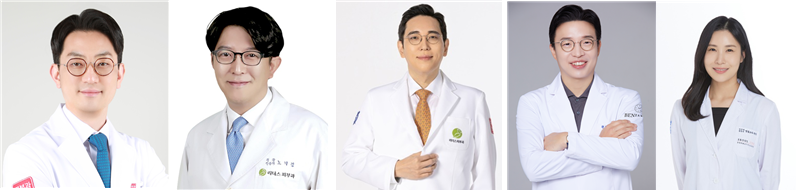
(From left) Korean Academy of Aesthetic Anti-Aging Dermatology (KAAD) Vice Presidents Hyun-Jo Kim, Nakyung Noh, and Sung-Jae Yoon, Executive Academic Director Sung-Min Noh, and Executive Secretary-General Kkot Bora Yeom.
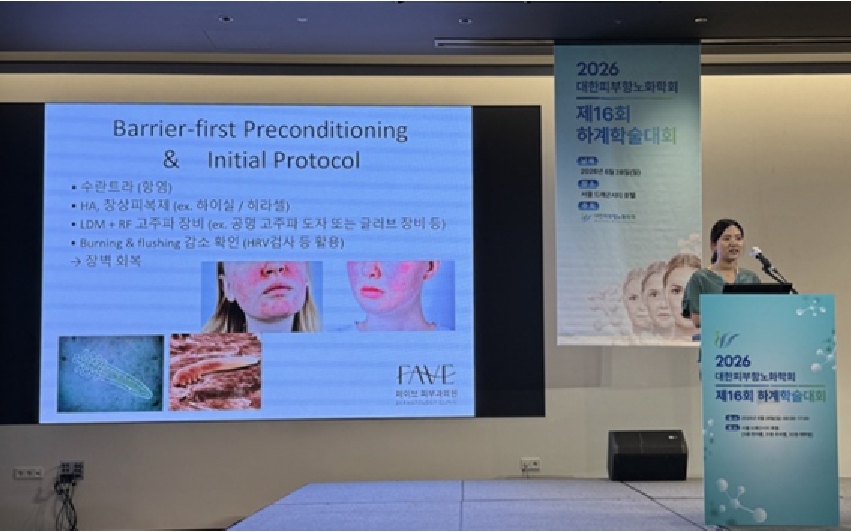
The Korean Academy of Aesthetic Anti-Aging Dermatology (KAAD) opened public discussion on this shift at its 16th Summer Academic Conference, held on the 28th, while strengthening members’ expertise as dermatologists and exploring the future direction of aesthetic medicine. A roundtable with the academy’s executives captured the conversations that didn’t make it onto the main stage. The roundtable featured Vice President Hyun-Jo Kim, MD, PhD (CNP Clinic, Seoul), Vice President Nakyung Noh, MD, PhD (Leaders Dermatology Clinic, Cheongdam Dosan-daero, Seoul), Vice President Sung-Jae Yoon, MD, PhD (Leaders Dermatology Clinic, Apgujeong, Seoul), Executive Academic Director Sung-Min Noh, MD, PhD (Benjamin Dermatology Clinic, Sinsa, Seoul), and Executive Secretary-General Kkot Bora Yeom, MD, PhD (Seoul ONE Dermatology Clinic).
■ Where is recent aging research focused?
Sung-Jae Yoon: Today, aging is understood not merely as the appearance of wrinkles and loss of elasticity, but as a systemic phenomenon shaped by the combined effects of cells, tissue, immunity, metabolism, the microbiome, and the living environment. Major research areas now include cellular senescence, chronic low-grade inflammation, declining mitochondrial function, oxidative stress, reduced stem cell function, abnormal cell-to-cell signaling, and changes in the gut-skin microbiome.
Kkot Bora Yeom: The field receiving the most attention right now is ‘inflammaging’ — the concept that chronic inflammation accelerates aging — which has rapidly emerged as a core research area. Active research is underway on therapies that block chronic micro-inflammation within cells to slow the pace of aging itself, on correcting gene expression patterns such as DNA methylation to reverse cells’ biological age, and on treatment mechanisms that regenerate the aged extracellular matrix (ECM) environment to normalize cell-to-cell communication.
■ Could you explain the concept of ‘Skin Longevity’ in simpler terms?
Hyun-Jo Kim: In short, it’s a concept oriented not toward youthful-looking skin, but toward skin that ‘functions healthily for a long time.’ It naturally emerged as the aging paradigm shifted from ‘treatment’ to ‘prevention and sustainability.’ While conventional aesthetic medicine focused on external outcomes such as wrinkles and volume loss, Skin Longevity focuses on preserving the skin’s fundamental regenerative capacity — its barrier function and collagen-producing ability — over the long term. Ultimately, the essence of Skin Longevity is a strategy for building skin that stays healthy ten years from now, not just skin that looks good today.
■ How can ‘Skin Longevity’ be put into practice?
Sung-Min Noh: There are proven anti-aging practices such as sun protection, retinoids, and antioxidants, alongside approaches like biostimulators, skin boosters, and lasers that stimulate the skin to regenerate collagen on its own.
Sung-Jae Yoon: What matters here is establishing a long-term treatment plan that takes into account one’s skin type, rate of aging, living environment, treatment history, and underlying health conditions. Rather than delivering a strong stimulus all at once, it’s important to set an appropriate treatment interval tailored to the individual to encourage natural regeneration.
Hyun-Jo Kim: Balanced management of the endocrine system is also necessary. Collagen synthesis, sebum regulation, and wound healing in the skin are all influenced by sex hormones. In men in particular, declining testosterone is directly linked to reduced skin elasticity, and a functional-medicine approach that addresses this clinically is also an important part of Skin Longevity.
■ What changes has the new paradigm brought to clinical practice?
Sung-Min Noh: In short, the focus has shifted from maximizing effect to ‘balancing effect and safety.’ In the past, going strong in a single session was seen as a mark of skill, but today the standard of expertise is doing ‘only as much as necessary, naturally, and within a recoverable range.’
Hyun-Jo Kim: There has been a noticeable increase in patients who ask, without hesitation, ‘Why does this treatment work?’ or ‘Is there safety data on it?’ As a result, I personally make it a principle to honestly explain the treatment mechanism, the supporting literature, and the expected course and limitations. I also maintain the practice of trying a new treatment myself first and recommending it to patients based on that experience.
Nakyung Noh: I agree. Lately, many patients ask whether their skin will continue to move and recover naturally over time. Even with a highly effective treatment, they worry that repeated procedures might cause tissue to stiffen — in other words, they place real importance on long-term safety. In clinical practice, we likewise focus on building treatment plans that support patients’ long-term aging management.
Kkot Bora Yeom: At the same time, the unfiltered spread of vast amounts of information through YouTube, social media, and AI has led to a growing distortion in which scientifically unverified claims are accepted on blind faith. As a result, the physician’s role is evolving from simply performing procedures to acting as an information filter and guide. We now need to be able to screen and correct the indiscriminate information patients bring in, based on medical evidence.
■ What do you think is most important in building rapport (trust) with patients?
Hyun-Jo Kim: It’s not mere familiarity, but ‘medical trust.’ I believe this trust is built through evidence-based explanations, restraint from over-recommending procedures, and a sense of responsibility that doesn’t avoid the issue when side effects occur.
Sung-Jae Yoon: Good rapport isn’t about ‘doing everything the patient asks for’ — it forms through the process of working together to find the treatment that’s truly most appropriate for the patient. Even if a patient wants change in one specific area, correcting a different area may actually be more urgent. A physician should be able to analyze the overall facial structure and the patient’s underlying causes of aging to propose the better long-term treatment direction.
Sung-Min Noh: You have to be able to read what the patient truly wants. Behind a request to ‘get rid of these wrinkles’ often lies the real wish to ‘look less tired.’ I think the key is reading the patient’s genuine wish and working together to align it with what is realistically achievable through treatment.
■ How should sustainable aesthetic medicine be realized?
Sung-Jae Yoon: It should be an approach that improves the current problem while still leaving room for future treatment options. Over-treating for the sake of immediate results can hinder natural, long-term aging management. It’s also important to be in harmony with the patient’s life — the goal isn’t to create a completely different face, but to help patients regain a natural, age-appropriate sense of health and confidence.
Kkot Bora Yeom: Ultimately, I think this aligns directly with the concept of Skin Longevity. Moving away from one-off procedures that overstimulate skin tissue or damage its structure purely for dramatic, immediate effect, and instead helping preserve and maintain the skin’s inherent health and value over the long term — I believe that is the foundation of sustainable aesthetic medicine.
■ What efforts does the academy plan to make going forward?
Nakyung Noh: I believe the academy’s role is to establish clear standards. We will focus on developing systematic guidelines so that aesthetic procedures such as Botox and fillers are performed not for fleeting effects, but according to standardized protocols with long-term safety built in.
Sung-Min Noh: We aim to build a culture in which good treatments are validated with data and shared openly. We will take the lead in systematically compiling domestic clinical experience into academic resources and presenting Korea-specific guidelines. We will also devote full effort to ensuring next-generation regenerative anti-aging medicine takes proper root in clinical practice. Technologies that intervene at the root of aging — such as stem cells, ECM, and cell-based regenerative therapies — should enter clinical use in a safe, validated form, and the academy must serve as the gateway for that validation and standardization.
Hyun-Jo Kim: Strengthening educational infrastructure is also essential. We will continue to provide a systematic academic platform so members can build expertise in step with new mechanisms and techniques. Expanding international cooperation is another important task. Korean dermatology already holds a strong reputation across Asia, but efforts to actively promote it to the world through papers and presentations at international conferences remain insufficient. The academy will play a central role in showcasing the excellence of Korean aesthetic medicine to the world.