

[Korea Medical Tourism] Korea's Vision-Correction Care Draws Global Attention... "One-Stop Programs Are a Key Driver"
[Seoul Medical Tourism Series 4] 17 Ophthalmology Clinics Registered with Seoul Medical Tourism Offer One-Stop Screening and Treatment, Centered in Gangnam
- Seoul Medical Tourism
- Korea Medical Tourism
- Medical Tourism Korea
- Seoul Medical Tourism (Korea)
- Seoul Tourism Organization
- Ophthalmology
- Vision correction surgery
- SMILE
- LASIK
- LASEK
- Eyesight
- Eye surgery
- Eye procedure
 이보람 기자
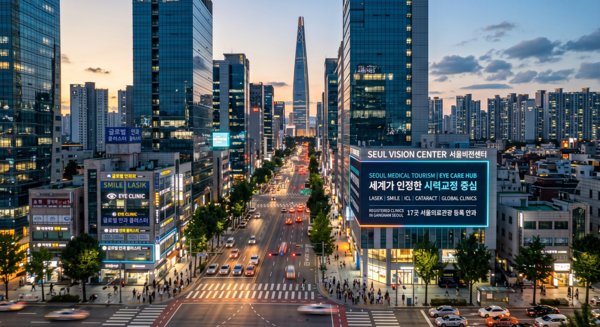
Seoul's medical tourism, once centered on K-beauty and cosmetic surgery, is now expanding into cutting-edge vision-correction care. Most of the 17 ophthalmology clinics registered with Seoul Medical Tourism are clustered around Gangnam-daero and Teheran-ro in Gangnam-gu, forming what has come to be called the "Gangnam eye clinic cluster."

■ Seoul's Eye Clinics: A Vision-Correction Hub the World Recognizes
The reason patients from the Americas, Europe, and Asia travel to Seoul for vision-correction surgery is clear. Compared with their home countries, they can access world-class laser equipment and extensive clinical experience at a reasonable cost. A one-stop program covering screening, the procedure, and recovery within a short stay has become a key driver in attracting international patients.
Korea, in particular, is considered a global leader in vision-correction procedure volume and clinical expertise, including in SMILE. Developed in Germany in 2008, SMILE has been performed more than 8 million times worldwide, with over 1.4 million of those procedures carried out in Korea — an overwhelmingly large share of the global total.
Clinics have also been actively adopting advanced laser and optical technologies, such as SMILE Pro," which significantly shortens laser treatment time for greater precision, and Implantable Collamer Lens (ICL) surgery for patients with extremely high myopia. Being able to complete precise screening and treatment on a short schedule while sightseeing at the same time gives Seoul a strong competitive edge in attracting overseas patients.


■ One-Stop Screening System and Multilingual Care Service
Above all, most ophthalmology clinics registered with Seoul Medical Tourism have built a "one-stop screening and treatment system" that accounts for how long foreign patients can stay. They have optimized patient flow so that more than 50 detailed eye examinations, consultations, and the procedure itself can be completed within a single day or a few days.
In addition, dedicated coordinators fluent in English, Chinese, Japanese, and Russian are on-site to provide one-on-one interpretation from consultation through post-operative follow-up, minimizing the language barrier. Consultations and inquiries can be made through the partner hospitals and clinics listed on the Seoul Medical Tourism website (https://medical.visitseoul.net/).

■ Same-Day Consultation and Safety First — Prior Confirmation Is Essential
Even on a fast-moving schedule, "safety" remains the top priority. The optimal procedure varies depending on factors such as corneal thickness, the degree of myopia, and the presence of dry eye. Depending on corneal topography or endothelial cell test results, an Implantable Collamer Lens (ICL) may be recommended instead of laser surgery, or surgery itself may not be possible. It is therefore advisable to share information such as long-distance travel plans and medication history through a remote consultation in advance when planning a schedule.
17 Ophthalmology Clinics Registered with Seoul Medical Tourism: First Samsung Eye Clinic, Samsung Miracle Eye Clinic, Glory Seoul Eye Clinic, Gangnam Tokyo Eye Clinic, Gangnam Cube Eye Clinic, Gangnam Joeunnun Eye Clinic, Gangnam iOne's Eye Clinic, Gangnam Central Eye Clinic, Gangnam Brand Eye Clinic, Gangnam Grand Eye Clinic, Sungmojin Eye Clinic, Balgeunnun Eye Clinic (Jamsil Lotte Tower Branch), Healing Eye Clinic, Dream Sungmo Eye Clinic, JC Bitsomang Eye Clinic, Balgeunnun Eye Clinic, Seoul Balgeun Sesang Eye Clinic


FAQ
Can vision-correction surgery be done in a single day?
Which is best — LASIK, LASEK, or SMILE?
Can I fly or go sightseeing right after the procedure?