

[Korea Medical Tourism] “From Inquiry to Departure”: 3 Field Experts on the Complete Guide to Seoul Medical Tourism
[Seoul Medical Tourism Complete Guide] From document prep to hospital selection, interpretation and lodging — a foreign patient’s treatment journey in Seoul, as told by industry experts
- Seoul medical tourism
- K-Medical
- foreign patients
- medical concierge
- Seoul Tourism Organization
- medical tourism partner organization
- medical visa
- GoodMedi Korea
- Red Table
- Jane DMC Korea
- foreign-patient recruitment agency
- medical interpretation
- Korea Health Industry Development Institute
 이보람 기자
As the global profile of K-Medical continues to rise, medical tourism has emerged as a cornerstone of South Korea’s national competitiveness. At the heart of this phenomenon is Seoul, a city where healthcare, tourism, transportation, accommodation, interpretation, and daily living infrastructure seamlessly converge.
For foreign patients, however, coming to Seoul does not end simply with “finding a good hospital and getting treated.” There is much to sort out before that: what materials to prepare back home, which hospital and medical team to choose, and then visas, entry, interpretation, lodging and post-treatment care. Ultimately, Seoul’s competitiveness as a medical tourism destination is built not just on the clinical quality of individual hospitals, but on the entire medical journey and environment that foreign patients experience in the city.
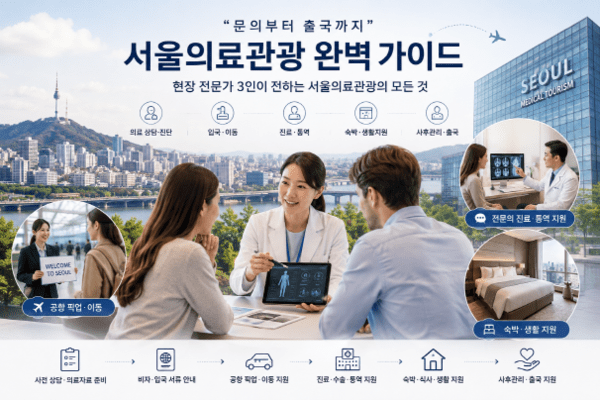
Standing on the front lines of this journey—directly meeting international patients and guiding them every step of the way—are Seoul’s official medical tourism partner organizations. The Seoul Metropolitan Government and the Seoul Tourism Organization select and operate partner organizations to build a medical and wellness tourism environment that foreign patients can trust, and 180 companies currently take part.
Kim Do-kyun, CEO of GoodMedi Korea; Do Hae-yong, CEO of Red Table; and Kang Kyung-ah, director at Jane DMC Korea — all active on the partner organizations’ operating committee — are right in the middle of that field. The three have handled a wide range of situations, from a foreign patient’s first inquiry to hospital selection, treatment and follow-up care. Drawing on their firsthand know-how, here is a step-by-step look at what a foreign patient’s medical tourism journey to Seoul actually looks like.
- When a foreign patient decides to seek treatment in Korea, what should they prepare first, back home?
Kim Do-kyun: The first step is to clearly define your goals for coming to Korea: what conditions or symptoms you are experiencing, what prior diagnoses and treatments you have received, and what specific tests or procedures you are hoping to get here. After that, it’s best to request a consultation with a trustworthy medical institution or a formally registered foreign-patient recruitment agency.
Do Hae-yong: The first thing to clarify is whether you need a “procedure” or a “surgery.” For procedure-centered fields like dermatology or dentistry, check the hospital’s location, main procedures offered, equipment, pricing and language support. For fields that require surgery, such as plastic surgery or ophthalmology, look closely at the surgeon’s experience and case volume, appointment availability, and the deposit and total treatment cost.
Kang Kyung-ah: For severe or complex cases, patients should first compile a comprehensive "medical narrative" detailing their clinical history, accompanied by a local physician's opinion letter, medical records, and diagnostic imaging (such as X-rays, MRIs, or CT scans). Lodging for the stay, expected treatment costs and living expenses should also be planned in advance to reduce trial and error.

- How detailed should photos or medical charts be for the preliminary consultation?
Kim Do-kyun: It’s best to prepare the core materials needed to accurately assess the current condition. For serious conditions, recent medical records, diagnosis reports, blood test results and pathology results, along with imaging such as CT, MRI or PET, are helpful. For dental cases, a panoramic X-ray, dental CT or intraoral photos are useful; for plastic surgery or dermatology, accurate current-state photos and a history of past surgeries or procedures matter. It also helps to summarize what the patient wants in one or two clear sentences — for example, writing something like “I’ve had lower back pain for three years, and numbness in my right leg has worsened recently; I want to find out whether surgery is needed in Korea” makes the consultation and communication far smoother.
- What about medical visas or required documents for entry?
Kang Kyung-ah: A dedicated medical visa is not always mandatory for getting treatment in Korea. Depending on your nationality and intended length of stay, you can often enter visa-free or under a standard tourist status to receive care. However, for long-term treatment or cases requiring a specific medical-purpose stay status, the visa requirements of the relevant country should be checked in advance. However, if a long-term medical stay is required, the visa application will be processed using an official treatment appointment certificate or supporting documents issued by the hospital. If treatment is likely to take longer, it’s best to confirm the required stay status and duration before entering the country.
- How is support provided during the treatment process, such as transportation?
Kim Do-kyun: Depending on the patient’s request and the scope of service, we can support airport pickup, dedicated vehicles, hotel check-in, transport to the hospital, and appointment scheduling. But if this is thought of as simple pickup or protocol service, it undersells what a medical concierge actually does. We check in advance whether the patient has a serious condition, is scheduled for surgery, needs a wheelchair, how many guardians are traveling with them, and how much luggage they have, then arrange transportation and routing suited to the patient’s condition.
Kang Kyung-ah: When requested, we sometimes bring in a specialized concierge company to provide close support for the entire journey, from arrival at the airport through lodging and the hospital. Patients with limited mobility or those about to undergo surgery, in particular, follow a different route than ordinary tourists, so advance preparation matters.
- After the hospital visit, how do interpretation during treatment and payment work?
Kim Do-kyun: When interpretation begins depends on the patient’s condition and the scope of service. For less common languages, we either secure specialized interpreters for that language in advance or use remote interpretation as needed.
Do Hae-yong: In the foreign-patient treatment process, some hospitals finalize the cost before treatment and process payment or a deposit. Once the final amount is set through consultation and the doctor’s examination, payment is settled before the procedure or surgery goes ahead.
Kang Kyung-ah: Because foreign patients typically confirm their schedule and enter the country afterward, tests and surgery dates are often scheduled efficiently. Payment can be made on-site or through an advance deposit, and when a prescription is needed, an interpreter-coordinator sometimes accompanies the patient to the pharmacy to help explain how to take the medication.
- There must be many questions about daily life too, such as meals and lodging, apart from treatment.
Kim Do-kyun: That’s right. In the field, we get almost as many questions about daily living as about medical matters. Muslim patients often ask about halal food or prayer space, and vegetarian patients ask about vegan restaurants or diets. For patients staying long-term, everyday matters such as laundry, grocery shopping, currency exchange, mobile phone and data use, and transportation also become important. Eliminating every non-medical inconvenience so that patients can focus entirely on their recovery is a core part of a medical concierge’s mission. Recruitment agencies often guide patients directly on these living services or connect them with related businesses.
- There are also concerns about illegal brokers. What’s the difference between booking directly as an individual and using a formal recruitment agency, and how can one tell a formal agency apart?
Kang Kyung-ah: Patients can look for a hospital and visit on their own, but if problems arise during treatment, they have to handle interpretation, communication with the hospital and administrative procedures alone — that’s a real burden. Using a formal recruitment agency means the patient can get support with guidance and communication with the hospital throughout treatment. From the patient’s side, it’s important to check whether the agency is formally registered as a foreign-patient recruitment business. To avoid falling victim to illegal brokers, patients should confirm the agency’s registration and business information before signing any contract or making a payment.
Do Hae-yong: Foreign patients can also verify registration directly through official information from the Seoul Tourism Organization or the Korea Health Industry Development Institute. Under Korean law, only businesses that meet certain requirements and are formally registered can carry out foreign-patient recruitment work.
- With so many hospitals in Seoul, what’s the recruitment agencies’ know-how for matching patients to the best hospital and doctor?
Kim Do-kyun: This is where a professional recruitment agency’s capability shows the most. You have to comprehensively judge the medical team’s expertise for the patient’s condition, their experience with similar cases, the hospital’s system for handling foreign patients, its international care infrastructure, medical interpretation support, and the possibility of post-treatment follow-up. Some patients arrive already set on a specific hospital or doctor famous overseas, but reviewing the medical materials sometimes shows that a different specialist or institution would be a better fit. In that case, it’s important not to simply book what the patient wants, but to explain why another option might be more suitable and present several choices. Uncovering the exact medical care a patient truly needs—rather than just blindly booking whatever hospital they ask for—is the hallmark of a skilled medical concierge.
Kang Kyung-ah: This really is an area where field experience and know-how matter. We need to find and guide patients to a medical institution suited to their disease and condition. For serious or cancer patients, we generally prioritize major university hospitals in Korea; for other conditions, we comprehensively consider the relevant field’s expertise, experience treating foreign patients, and the hospital’s support system when matching an institution.
- Finally, what would you like to say to foreign patients considering a visit to Seoul?

Kim Do-kyun: Seoul’s competitive edge in medical tourism stems not only from its world-class healthcare services, but also from its ability to offer effortless access to top-tier transportation, lodging, culinary, shopping, and cultural tourism infrastructure all in one place. On top of that, there is the “Seoul Medical Concierge” offered by the Seoul Tourism Organization and its partner organizations. Beyond providing good hospitals and medical technology, it connects medical care, interpretation, transportation, lodging, living support, tourism and follow-up care into a single medical journey, so foreign patients can receive treatment with peace of mind in an unfamiliar city. Seoul is also home to everything from world-class large medical institutions to specialized hospitals and clinics in every field, offering services from health checkups to cancer and serious illness care, orthopedics, ophthalmology, dentistry, plastic surgery and dermatology, and Korean traditional medicine.

Do Hae-yong: South Korea's medical technology excels largely because the nation's top academic talents are heavily concentrated within its healthcare system. There is also rich clinical experience treating Korean patients, which translates into experience treating related conditions. And because competition within Korea is intense, prices are also competitive compared to other countries. The Korean government also oversees hospitals and doctors, so if a medical accident does occur, it is handled smoothly, making treatment safer. In sum, Korea is a medical tourism destination with excellent, safe and affordable care.

Kang Kyung-ah: K-Medical’s standing in the global medical market has already been proven. With an excellent medical system, high-level medical technology and price competitiveness, attracting foreign patients has become an important part of Korea’s medical sector. What matters now is going a step further than having good medical technology — carefully connecting the entire medical journey, from the moment a foreign patient arrives in Korea through treatment and back to daily life, so there are no inconveniences along the way. As the Seoul Tourism Organization and its partner organizations continue building a safe and convenient medical tourism environment on the ground, we hope foreign patients visiting Seoul can focus on their treatment with peace of mind.
What is a Seoul Medical Tourism Partner Organization?
A Seoul Medical Tourism Partner Organization is a Seoul-based institution — a medical facility, agency, wellness provider or other tourism service provider (lodging, experiences, etc.) — selected and operated by the Seoul Metropolitan Government and the Seoul Tourism Organization to build a medical and wellness tourism environment that foreign patients can trust. Selection takes place once every three years; the current group of partner organizations, active from 2025 to 2027, numbers 180 companies.